Tommy Lee Walker: CRRJ and the Innocence Project Secure Declaration of Innocence in 70-Year-Old Texas Execution Case
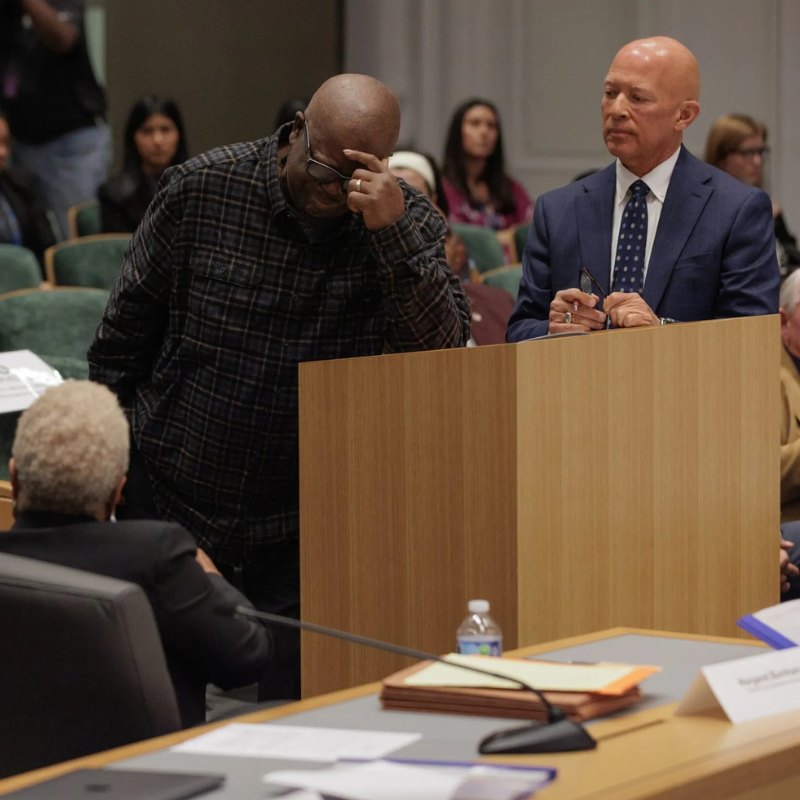
01.21.26 — Northeastern Law’s Civil Rights and Restorative Justice Project (CRRJ), in partnership with the Innocence Project of New York, has successfully advocated for official recognition of one of the most infamous miscarriages of justice in Texas history. Following extensive research and advocacy by CRRJ, the Dallas County District Attorney’s Office has acknowledged that 19-year-old Tommy Lee Walker was wrongfully convicted and executed for the 1953 murder of Venice Lorraine Parker.
On January 21, after a three-hour hearing, the Dallas County Commissioners Court declared that Tommy Lee Walker “was and is innocent” of the crime for which he was executed by the State of Texas.
In 2022, the case was submitted to the Dallas County District Attorney’s Conviction Integrity Unit by CRRJ and the Innocence Project, on behalf of Edward Lee Smith, Mr. Walker’s son. Smith was represented at the hearing on January 21 by CRRJ Director and Northeastern Law Professor Margaret Burnham. This case is the oldest case investigated to date by Conviction Integrity Unit.
 Under Burnham’s leadership — with support from CRRJ Staff Attorney and Program Director Alex Stein, and in partnership with the Innocence Project, the Conviction Integrity Unit — NUSL students and staff conducted meticulous historical research, uncovering evidence of constitutional violations, including coercive interrogation tactics and unreliable eyewitness identifications that permeated every aspect of Mr. Walker’s prosecution.
“At the end of the day, our criminal justice system must address its fatal errors, no matter how long ago they occurred,” said Northeastern Law Professor Margaret Burnham, CRRJ director and co-counsel to Mr. Smith. “This is the thrust of all our work. Clearing Mr. Walker’s name acknowledges him as a legally cognizable being, entitled — even after death — to justice, brings a measure of peace to his loved ones, and salutes those who, 70 years ago, fought to obtain justice for him — and for themselves. This case reminds us of how much must still be done to map the lethality and legacy of Jim Crow terror.”
CRRJ’s investigation revealed that Mr. Walker, a Black teenager expecting the birth of his first child, was arrested during a period of heightened racial tensions in Dallas. The city’s white community, gripped by fear over reports of a “Negro Prowler,” pressured police to make an arrest. Hundreds of Black men were rounded up based solely on the color of their skin before suspicion fell on Mr. Walker.
The investigation uncovered that Mr. Walker was interrogated by Dallas Police Captain J. Will Fritz, a one-time member of the Ku Klux Klan, who employed coercive tactics now known to produce false confessions. Despite having multiple alibi witnesses who placed him at his pregnant girlfriend’s side during the crime, Mr. Walker was convicted by an all-white, all-male jury and ultimately executed. Mr. Walker’s son was born just hours after the crime took place.
Mr. Smith reflected on the significance of this acknowledgment. “It was hard growing up without a father,” he said. “When I was in school, kids talked about their dads, and I had nothing to say. This won’t bring him back, but now the world knows what we always knew — that he was an innocent man. And that brings some peace.”
CRRJ’s research documented numerous constitutional violations in Mr. Walker’s case, including the denial of his constitutional right to a jury of his peers; suppression of evidence contradicting physical evidence and witness descriptions; coercive interrogation techniques; prosecutorial misconduct by then-District Attorney Henry Wade; and an over-reliance on eyewitness identification now known to be unreliable.
The case reflects CRRJ’s mission to investigate historical cases of racial injustice and wrongful convictions, particularly those involving racial terror and systemic discrimination in the Jim Crow era. By partnering with district attorneys’ offices and conviction integrity units, CRRJ works to bring truth and accountability to cases long obscured by time and deliberate erasure.
In its official statement, the Dallas County District Attorney’s Office acknowledged that “Tommy Lee Walker’s conviction is based on false evidence and unethical prosecution” and stated unequivocally: “With the evidence available to us and the knowledge we have obtained over decades of scientific study, the Dallas County District Attorney’s Office of today would not have pursued a criminal case against Mr. Tommy Lee Walker for the sexual assault and murder of Venice Parker.”
This recognition by public officials in Dallas County that an innocent Black teenager was killed by the State for a crime he did not commit represents a significant victory for restorative justice and demonstrates the vital role that CRRJ has played in uncovering historical wrongs. Under the auspices of its Wrongful Conviction Project CRRJ continues to investigate similar cases across the country, working to ensure that the stories of those denied justice are finally told and their names are cleared.
Press Coverage
- “70 Years After Execution, Northeastern Helps Clear Wrongfully Convicted Black Man,” Northeastern Global News (February 9, 2026).
- “Highlights for ‘ABC News Live Prime with Linsey Davis,’ Feb. 2–6,” ABC News (January 30, 2026).
- “Texas Black Man Exonerated Nearly 70 Years After Execution in Case Marked by Racial Bias,” LA Sentinel (January 27, 2026).
- “Texas Black Man Exonerated Nearly 70 Years After Execution in Case Marked by Racial Bias,” US News (January 23, 2026).
- “Black Man Who Was Executed in Texas 70 Years Ago Is Cleared in Case Marked by Racial Bias,” NBC News (January 23, 2026).
- “Tommy Lee Walker Exonerated Nearly 70 Years After Wrongful Execution,” BET (January 23, 2026).
- “Dallas Man Exonerated 70 Years After His Conviction,” The Grio (January 23, 2026).
- “Black Teen Wrongly Executed For Murder Exonerated Over 70 Years Later,” Black Information Network (January 23, 2026).
- “US Black Man Exonerated Nearly 70 Years After Execution in Case Marked by Racial Bias,” Jamaica Gleaner (January 23, 2026).
- “Black Teenager Convicted and Executed for White Woman’s Murder Finally Exonerated Over 7 Decades Later,” UNILAD (January 23, 2026).
- “Dallas County Commissioners Court Declares Innocence of Tommy Lee Walker, Convicted of Murder in 1950s,” The Texan News (January 22, 2026).
- “A Texas Man Was Found Innocent 70 Years After the State Executed Him,” Scheer Post (January 22, 2026).
- Video: “Dallas County Declares Tommy Lee Walker's 1956 Execution Wrongful; Brings Closure to Families 70 Years Later,” WFAA TV (January 22, 2026).
- “Dallas County Exonerates Black Man Who Was Executed in 1956,” The New York Times (January 22, 2026).
- “I Have Been Tricked Out of My Life”: Dallas Man Exonerated 70 Years After Execution,” Death Penalty Information Center (January 22, 2026).
- “Dallas Admits Wrongful Execution Driven by Racial Hysteria and Jim Crow Laws,” Vanguard News Group (January 22, 2026).
- “Dallas County Fomally Declares Wrongful cCnviction of Tommy Lee Walker,” Audacy (January 22, 2026).
- “In a Historic Resolution, Tommy Lee Walker Is Declared Innocent 70 Years After His Execution in Dallas,” Innocence Project Press Release (January 21, 2026). .
- “Tommy Lee Walker Exonerated 70 Years After Execution for Rape and Murder of Venice Parker,” ABC News (January 21, 2026).
- Video: “Dallas Man Wrongfully Executed for Murder 70 Years Ago is Set to be Exonerated,” CBS Texas (January 21, 2026).
- “Texas Executed a Black Man with an Alibi. Now, Contrition,” MSN (January 21, 2026).
- “Tommy Lee Walker, the Black Dallas Man Executed for 1954 Murder, Declared Innocent,” Dallas Observer (January 21, 2026).
- “In a Historic Resolution, Tommy Lee Walker Is Declared Innocent 70 Years After His Execution in Dallas,” D Magazine (January 21, 2026).
- “Posthumous Justice For Tommy Lee Walker: Dallas Declares Black Man Innocent 70 Years After Wrongful Electric Chair Death,” Dallas Express (January 21, 2026).
- “Tommy Lee Walker Exonerated Seven Decades Post-Execution,” El Balad (January 21, 2026).
- Video: “Dallas Man Executed for 1954 Murder Declared Innocent,” Fox 4 KDFW (January 21, 2026).
- “Dallas County Symbolically Exonerates Tommy Lee Walker, Nearly 70 Years After Execution,” (January 21, 2026).
- “Dallas Leaders Revisit Tommy Lee Walker's Case,” NBC News (January 20, 2026).
- “Dallas County Leaders Could Right a Wrong from City's Segregated Past,” NBC 5 Dallas Fort Worth News (January 20, 2026).
- “Dallas Set To Exonerate Man Wrongfully Executed for Murder 70 Years Ago,” CBS News (January 19, 2026).
About Northeastern University School of Law
The nation’s leader in experiential legal education since 1968, Northeastern University School of Law offers the longest-running, most extensive experience-based legal education program in the country. Northeastern guarantees its students unparalleled practical legal work experiences through its signature Cooperative Legal Education Program. More than 1,100 employers worldwide in a wide range of legal, government, nonprofit and business organizations participate in the program. With a focus on social justice and innovation, Northeastern University School of Law blends theory and practice, providing students with a unique set of skills and experiences to successfully practice law.
For more information, contact [email protected].