Imagine Legal Design as a Civic, Community-Driven Practice Rather Than a Set of Service Improvements.
08.21.25 — In the United States, the legal system is straining under compounding pressures—intensified immigration enforcement, unstable legal aid funding, and deepening disconnection from public institutions. This breakdown is not merely procedural; it erodes the civic infrastructure that sustains participation in democratic life.
This crisis demands that legal designers look beyond usability fixes and service delivery improvements. It calls for a deeper reckoning with how law is experienced—as exclusion, fear, and civic invisibility. This reality poses a profound challenge for the fields of law and design.
A new dissertation by Jules Rochielle Sievert, creative director of Northeastern Law’s NuLawLab, urges a reimagining of legal design from the perspective of those most excluded from it. We are facing a civil justice crisis that is both structural and civic in nature.
“Law is not a fixed system but a dynamic, relational force, one that shapes how we experience and navigate the world, and one we can reshape through how we respond. Law is a living system, evolving through collective care, conflict, and transformation. But it also carries violence, structural, procedural, and often invisible,” says Sievert, co-editor of Legal Design: Dignifying People in Legal Systems, a groundbreaking guide to legal design.
Sievert continues, “This violence is felt in the body—through stress, displacement, and survival—and embedded in place, shaped by politics and neighborhood life, housing, and space. However, agency is our capacity to respond to these forces. It is fortified through relationships—how we listen, organize, and share power, agency is also carried through story and memory, which hold histories of harm, resilience, and resistance.”
In their dissertation, Sievert introduces a fresh framework, Transformative Transdisciplinary Legal Design (TTLD), which offers a set of new theoretical lenses applied to legal design. It treats law as co-produced civic knowledge rather than a professional service, advances peer-led legal empowerment and collective legal authorship, and grounds legal design in place-based, cultural, and community-driven practice. Drawing from spatial justice, critical legal empowerment, participatory action research, ontological design, and posthumanism, TTLD reimagines legal systems as civic, relational, and co-created rather than merely procedural or service oriented. It positions justice-centered design to confront structural inequality, civic disenfranchisement, and the spatialized effects of policy violence
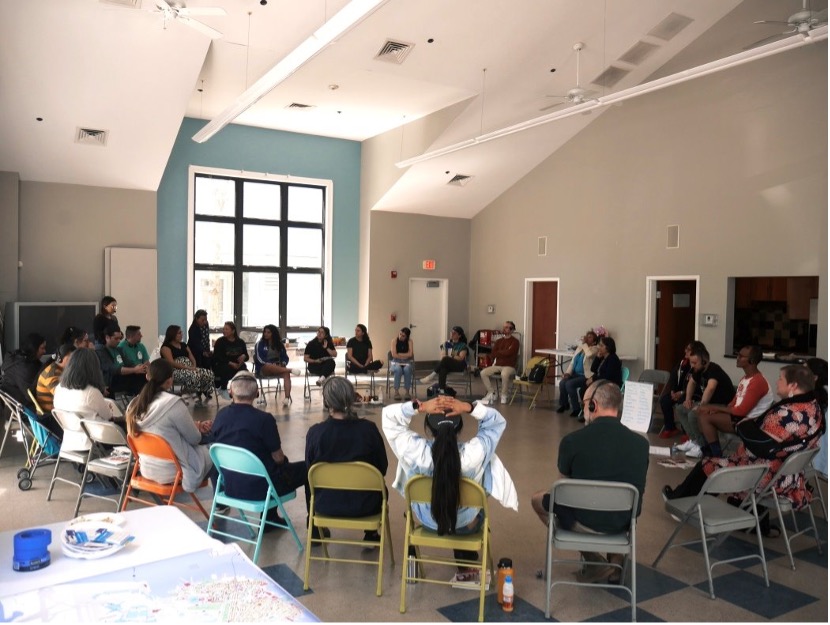
The dissertation includes a case-based analysis from the East Boston Spatial Justice Lab, where TTLD was implemented through learning pods, participatory design sessions, popular education, and community-led research. Together, these strategies created new civic spaces for residents to author legal meaning, assert housing justice claims, and reimagine what “access to justice” means.
“Design can’t be neutral when systems are broken by design,” says Sievert. “We need legal infrastructures that are co-authored with communities, not imposed upon them.”
As one of the first scholars to graduate from Northeastern University’s PhD program in Interdisciplinary Design and Media with a focus on civic legal empowerment, Sievert’s work lays a foundation for legal transformation in the face of widespread civil justice failures.
Their model has already begun influencing legal empowerment efforts, policy training programs, and grassroots organizing across the region.
Sievert’s publications include “Dignifying Imagination in Legal Education” in Legal Design: Dignifying People in Legal Systems and “Transforming Communities: Addressing Housing Instability Through Art, Advocacy, and Collective Action” in The Routledge Handbook of Urban Cultural Planning. In 2026, their article, “Rethinking Legal Design,” will be published in The Socio-Politics of Legal Design and Its Epistemic Consequences.
East Boston Spatial Justice Lab 2025

Photographs by Jules Rochielle and Gabriela Cartagena
The nation’s leader in experiential legal education since 1968, Northeastern University School of Law offers the longest-running, most extensive experience-based legal education program in the country. Northeastern guarantees its students unparalleled practical legal work experiences through its signature Cooperative Legal Education Program. More than 1,100 employers worldwide in a wide range of legal, government, nonprofit and business organizations participate in the program. With a focus on social justice and innovation, Northeastern University School of Law blends theory and practice, providing students with a unique set of skills and experiences to successfully practice law.
For more information, contact [email protected].